註冊
掃碼下載
iOS & Android

ZKsync (ZK)

$
$ 0.011 (ZK/USD)
-1.99%
24H

ZKsync 實時價格數據

今日ZKsync的實時價格為$ 0.011 (ZK/USD) 當前市值為 $ 116.92M USD 24小時的成交量為 $ 498.15K USD 過去24小時內漲跌幅為 -1.91% 流通量為 9.90B ZK

ZKsync ZK 價格歷史 USD

跟蹤 ZKsync 的今日價格、7天、30天和90天價格
週期
漲跌
漲跌幅 (%)
今日
$ 0.00023
-1.99%
7日
$ 0.00065
5.92%
30日
$ 0.0039
-25.06%
90日
$ 0.0057
-32.82%

立刻擁有ZK

在 BitMart 輕鬆、安全地買賣ZK
立刻買賣ZK
立刻買賣{0}
ZKsync 市場信息
最新價 $ 0.011
$ 0.011 24小時價格浮動區間 $ 0.012
歷史最高
‎$ 0.28‎
歷史最低
‎$ 0.0045‎
24小時漲跌幅
‎-1.91%‎
24小時交易量
‎$ 498,148.29‎
流通供給
9.90B ZK
市值
‎$ 116.92M‎
最大供給
21.00B ZK
完全稀釋的市值
‎$ 247.94M‎
交易 ZK

理財產品

輕鬆開啟理財之旅,餘幣寶、鏈上質押,多種產品讓閒置資產穩健增值。
立即申購
立即申購

ZKsync 社交媒體動態

avatar
ZKsync paves the way for large-scale institutional adoption of crypto assets by solving the institutional custody challenge.

Custody Is the Quiet Gate Every Institutional Settlement Network Has to Clear First

Most analysis of onchain settlement counts banks. The more useful thing to count is custodians, because a regulated institution cannot settle an asset it cannot first hold under its own compliance rules.

This is the step that gets skipped in the excitement about tokenized deposits and tokenized funds. Settlement and custody are not the same problem. A bank can be convinced the rails are fast and final and still be unable to touch them, because its mandate requires qualified custody with specific controls over keys, segregation, and audit. No custody path means no participation, regardless of how good the settlement layer is.

That is why the BitGo institutional custody and wallet integration with Prividium matters more than its size suggests. It is not one more logo. It removes the precondition that blocks every incoming institution before settlement is even on the table.

Consider the order of operations a regulated entity actually follows:

• It must custody the asset within a framework its regulator already accepts.
• Only then can it settle, because settlement moves assets that have to be held somewhere compliant at rest.
• Only then do network effects apply, because a corridor needs two institutions that can both hold and move.

Seen this way, the deployments on @zksync rails are not parallel announcements. They are a sequence. Custody integration is the part that converts a settlement layer from a demo into something an incoming bank can actually onboard to, because the holding problem was solved before the bank arrived.

The architecture underneath is what makes this hold together rather than a set of separate vendor relationships. Banks execute inside private environments where only zero-knowledge proofs and state commitments reach Ethereum, settlement is final without optimistic challenge windows, and the same stack carries custody, execution, and interop instead of stitching them across teams.

Here is the part worth contesting: the institutional race in 2026 will not be decided by whoever has the fastest proofs or the most famous bank logo. It will be decided by whoever made it boring and compliant to hold the asset in the first place, because that is the step that quietly gates all the others.

For anyone who has actually sat through an institutional custody and settlement review, which gate really decides whether a bank can join a network: the speed of settlement, or the holdability of the asset at rest?
view 92
view 42
view 3.0K
2026-06-20 17:38
發佈後ZK走勢
極度看漲
ZKsync paves the way for large-scale institutional adoption of crypto assets by solving the institutional custody challenge.
avatar
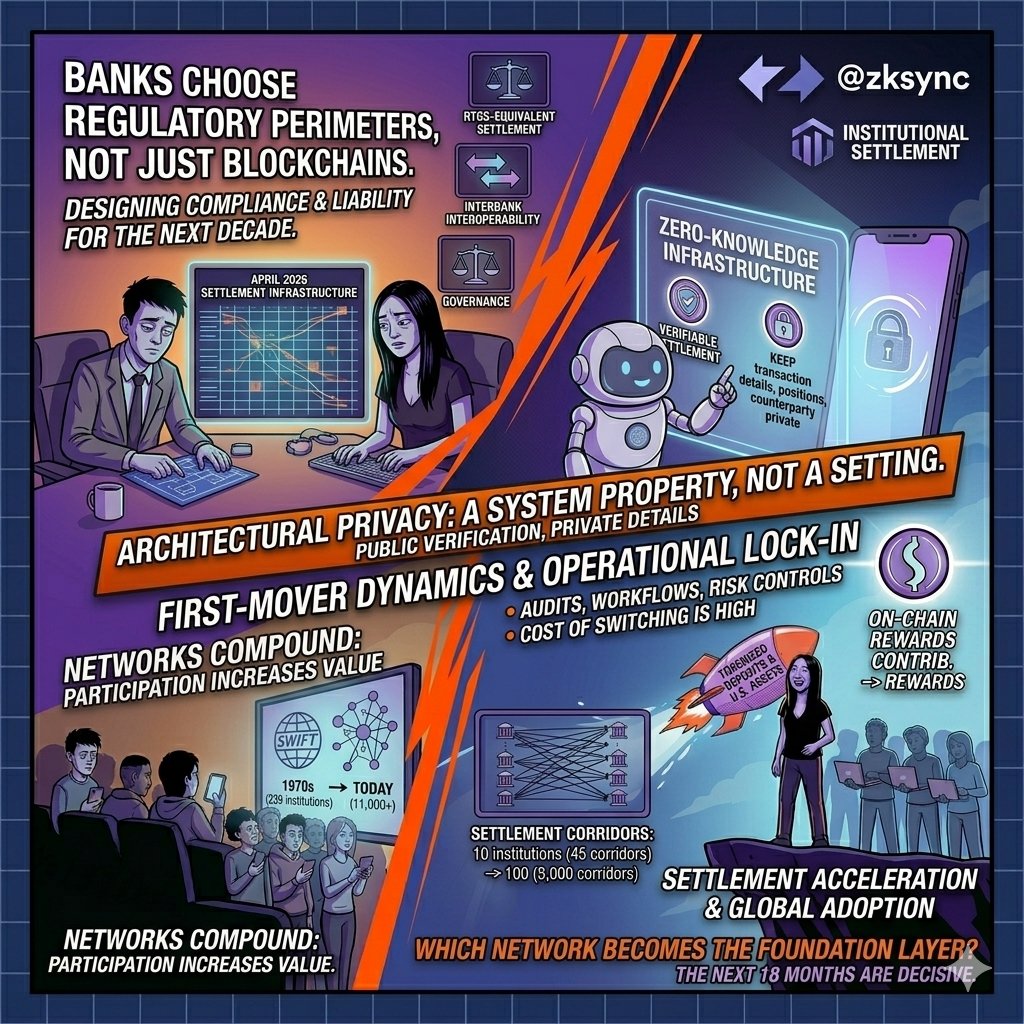
zkSync has a leading advantage in institutional settlement due to its zero-knowledge architecture, and the next 18 months are critical.

Banks aren’t choosing a blockchain. They’re choosing the regulatory perimeter they’ll operate inside for the next decade.

That’s what the 2026 settlement infrastructure decision is really about.

Right now, institutions are evaluating a set of unresolved questions that the April 2026 GFMA report identified as critical for institutional onchain finance: interbank interoperability for tokenized deposits, transaction privacy, RTGS-equivalent settlement, and governance for digital money.

These are not isolated technical features. Together, they determine whether a settlement rail can support regulated financial activity across jurisdictions.

Every rail exposes information differently. What a regulator can access, what a counterparty can infer, what an infrastructure operator can reconstruct. Those design choices shape compliance obligations, liability frameworks, and ultimately which markets a bank can operate in.

This is why privacy has become a structural issue rather than a product feature.

A privacy model that works for one jurisdiction may fail in another if confidentiality depends on permissions that can be altered later. For global institutions, privacy increasingly needs to be architectural: a property of the system itself rather than a setting that can be switched on or off.

That changes the importance of zero-knowledge infrastructure.

Instead of forcing institutions to choose between transparency and confidentiality, zero-knowledge systems allow settlement validity to be publicly verified while keeping transaction details, positions, strategies, and counterparty relationships private. Regulators can receive verifiable access without exposing sensitive information across the entire network.

For banks evaluating long-term settlement rails, that distinction matters.

The market opportunity is no longer theoretical. JPMorgan’s Kinexys platform has processed more than $1.5 trillion in transaction volume. DTCC is advancing tokenized Treasury infrastructure under existing regulatory frameworks. NYSE, BNY, and Citi are building tokenized securities rails. Meanwhile, the majority of tokenized U.S. assets already settle on Ethereum-based infrastructure.

The institutions entering these networks today are not simply choosing technology. They are helping define the standards future participants will inherit.

That is where first-mover dynamics become powerful.

Financial infrastructure compounds differently from consumer technology because adoption creates operational lock-in. Once a bank integrates a settlement rail, the costs of switching extend far beyond software migration. Institutions must repeat audits, satisfy regulators, rebuild operational workflows, renegotiate counterparty agreements, and re-establish risk controls that may have taken years to construct.

History shows how durable these effects can become.

SWIFT began with 239 institutions in the 1970s. Today it connects more than 11,000 financial institutions globally. Its dominance was not driven by superior technology alone. It persisted because every new participant increased the value of the existing network while raising the cost of choosing an alternative.

Settlement infrastructure follows the same logic.

Ten institutions create 45 potential settlement corridors. One hundred create nearly 5,000. Each additional participant increases not only transaction volume but also the number of relationships available through the network. The result is an asymmetry where the leading network's advantage compounds faster than competitors can replicate.

This is why @zksync is worth watching in the institutional race.

Its zero-knowledge architecture addresses one of the most difficult constraints identified by global financial institutions: achieving verifiable settlement while preserving confidentiality across jurisdictions. As more regulated deployments move onchain, infrastructure capable of satisfying both regulatory oversight and privacy requirements becomes increasingly valuable.

The key question is no longer whether institutional finance moves onchain.

That transition is already underway.

The question is whether privacy-preserving settlement standards can achieve sufficient adoption before regulatory fragmentation hardens into separate regional systems.

History suggests that once regulated institutions converge on a settlement standard, displacement becomes increasingly uneconomic.

The next 18 months may determine which networks become the foundation layer for institutional settlement in the decade ahead.

view 52
view 35
view 2.6K
2026-06-20 13:57
發佈後ZK走勢
看漲
zkSync has a leading advantage in institutional settlement due to its zero-knowledge architecture, and the next 18 months are critical.
avatar
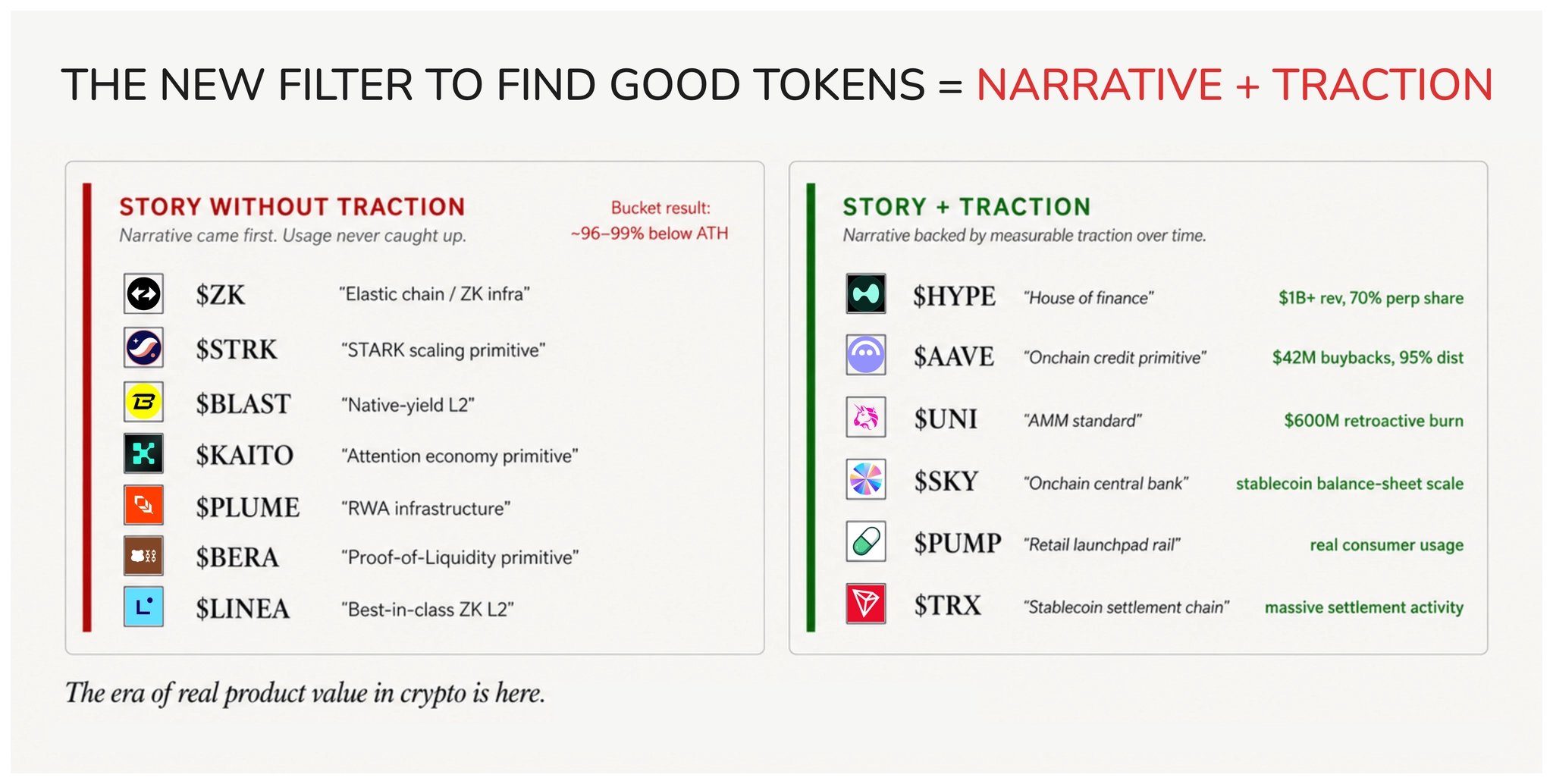
The market is shifting from pure narrative to emphasizing actual project value and data support, and tokens with real use cases perform better.
avatar

The market is becoming more selective.

I think the easy narrative trade is getting weaker because investors now want proof.

A clean story can still attract attention, But attention alone does not create durable repricing.

The comparison is simple:

On one side, you have tokens where the narrative came first and the usage never caught up.

The market has been brutal to that bucket:

→ $ZK, $STRK, $BLAST, $KAITO, $PLUME, $BERA, $LINEA each is down **~96-99% from ATH.**

→ All had narratives people understood, but the market no longer pays full price for projected adoption.

I don’t think the market rejected these sectors from first bucket completely.

AI attention, RWA, liquidity design, and ZK infra are still valid narratives.

The problem is that narrative without revenue, user retention, real demand, or capital flow becomes hard to defend when liquidity tightens.

When the market is risk-on, people buy future potential.

When the market becomes selective, people find real tractions such as revenue, usage,

view 94
view 28
view 9.4K
2026-06-20 12:12
發佈後ZK走勢
看漲
The market is shifting from pure narrative to emphasizing actual project value and data support, and tokens with real use cases perform better.
詳情

價格預測

什麼時候是購買ZK的好時機?我應該現在買入還是賣出ZK?

在判斷現在是否是買入或賣出 ZKsync (ZK) 的合適時機時,首先需要結合自身的交易策略和風險承受能力。長期投資者與短期交易者對市場信號的解讀往往不同,因此建議根據個人交易計劃做出決策。 根據最新的 ZK 4 小時技術分析,當前交易信號為持有。 根據最新的 ZK 1 天技術分析,當前交易信號為賣出。
52
持有
ZK的4小時技術分析
最後更新時間:2026-06-21 15:59:59
38
賣出
ZK的1天技術分析
最後更新時間:2026-06-22 00:00:00
beacon

Beacon預測

概率價格預測(未來24小時)
i
Beacon預測免責聲明
當面頁面的數據結果基於當前交易對的實際交易數據(OCHLV)和相應的指標計算,然後進行分析得出結果。
此預測為實驗性技術產品,僅供參考,不構成投資建議。現實生活中的任何突發事件都可能對交易行為產生重大影響,因此交易者應謹慎決策。
關於 ZKsync
ZKsync (ZK) is a cryptocurrency launched in 2024and operates on the zkSync Era platform. ZKsync has a current supply of 14,749,884,093.83028423 with 9,903,078,431.07266912 in circulation. The last known price of ZKsync is 0.01180238 USD and is up 1.44 over the last 24 hours. It is currently trading on 266 active market(s) with $16,648,551.40 traded over the last 24 hours. More information can be found at https://zksync.io/.
查看更多
購買 ZK
交易 ZK