Iniciar
Escanear para Baixar o Aplicativo
IOS e Android

ZKsync (ZK)

$
$ 0.011 (ZK/USD)
-2.89%
24H

ZKsync Dados de preços ao vivo

O preço atual de ZKsync é $ 0.011 (ZK/USD). Com um Market Cap de $ 116.13M USD, Volume de Trading em 24 horas de $ 499.75K USD, Uma Variação de Preço em 24 horas de -2.73%, E um Fornecimento Circulante de 9.90B ZK.

ZKsync ZK Histórico de Preços USD

Acompanhe o preço de ZKsync hoje e nos últimos 7, 30 e 90 dias
Período
Mudar
Alterar (%)
Hoje
$ 0.00034
-2.89%
7Dias
$ 0.00047
4.26%
30Dias
$ 0.0039
-25.27%
90Dias
$ 0.0058
-33.22%

Adquira ZK agora

Compre e venda ZK de forma fácil e segura na BitMart.
Compre/Venda ZK agora
Compre/Venda {0} agora
ZKsync Informações de mercado
Último preço $ 0.011
$ 0.011 Intervalo de 24h $ 0.012
Máximo histórico
‎$ 0.28‎
Mínimo histórico
‎$ 0.0045‎
Alteração 24h
‎-2.73%‎
24h Vol
‎$ 499,747.62‎
Fornecimento circulante
9.90B ZK
Capitalização de mercado
‎$ 116.13M‎
Fornecimento máximo
21.00B ZK
Capitalização de mercado totalmente diluída
‎$ 246.25M‎
Comércio ZK

Ganhar

Coloque suas criptomoedas ociosas para trabalhar e ganhe renda passiva com poupança, staking e muito mais.
Experimente Agora
Experimente Agora

ZKsync X Insight

avatar
ZKsync paves the way for large-scale institutional adoption of crypto assets by solving the institutional custody challenge.

Custody Is the Quiet Gate Every Institutional Settlement Network Has to Clear First

Most analysis of onchain settlement counts banks. The more useful thing to count is custodians, because a regulated institution cannot settle an asset it cannot first hold under its own compliance rules.

This is the step that gets skipped in the excitement about tokenized deposits and tokenized funds. Settlement and custody are not the same problem. A bank can be convinced the rails are fast and final and still be unable to touch them, because its mandate requires qualified custody with specific controls over keys, segregation, and audit. No custody path means no participation, regardless of how good the settlement layer is.

That is why the BitGo institutional custody and wallet integration with Prividium matters more than its size suggests. It is not one more logo. It removes the precondition that blocks every incoming institution before settlement is even on the table.

Consider the order of operations a regulated entity actually follows:

• It must custody the asset within a framework its regulator already accepts.
• Only then can it settle, because settlement moves assets that have to be held somewhere compliant at rest.
• Only then do network effects apply, because a corridor needs two institutions that can both hold and move.

Seen this way, the deployments on @zksync rails are not parallel announcements. They are a sequence. Custody integration is the part that converts a settlement layer from a demo into something an incoming bank can actually onboard to, because the holding problem was solved before the bank arrived.

The architecture underneath is what makes this hold together rather than a set of separate vendor relationships. Banks execute inside private environments where only zero-knowledge proofs and state commitments reach Ethereum, settlement is final without optimistic challenge windows, and the same stack carries custody, execution, and interop instead of stitching them across teams.

Here is the part worth contesting: the institutional race in 2026 will not be decided by whoever has the fastest proofs or the most famous bank logo. It will be decided by whoever made it boring and compliant to hold the asset in the first place, because that is the step that quietly gates all the others.

For anyone who has actually sat through an institutional custody and settlement review, which gate really decides whether a bank can join a network: the speed of settlement, or the holdability of the asset at rest?
view 92
view 42
view 3.0K
2026-06-20 17:38
Tendência de ZK após o lançamento
Extremamente Bullish
ZKsync paves the way for large-scale institutional adoption of crypto assets by solving the institutional custody challenge.
avatar
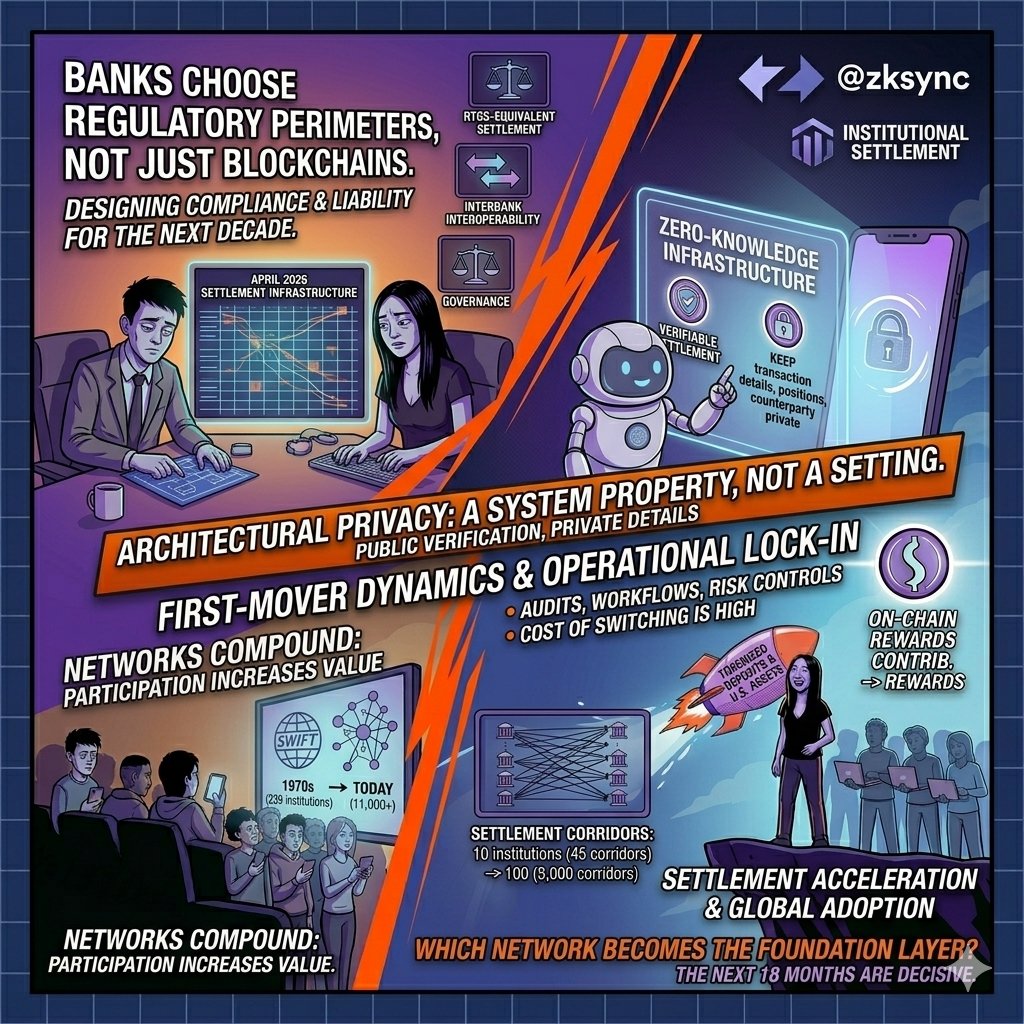
zkSync has a leading advantage in institutional settlement due to its zero-knowledge architecture, and the next 18 months are critical.

Banks aren’t choosing a blockchain. They’re choosing the regulatory perimeter they’ll operate inside for the next decade.

That’s what the 2026 settlement infrastructure decision is really about.

Right now, institutions are evaluating a set of unresolved questions that the April 2026 GFMA report identified as critical for institutional onchain finance: interbank interoperability for tokenized deposits, transaction privacy, RTGS-equivalent settlement, and governance for digital money.

These are not isolated technical features. Together, they determine whether a settlement rail can support regulated financial activity across jurisdictions.

Every rail exposes information differently. What a regulator can access, what a counterparty can infer, what an infrastructure operator can reconstruct. Those design choices shape compliance obligations, liability frameworks, and ultimately which markets a bank can operate in.

This is why privacy has become a structural issue rather than a product feature.

A privacy model that works for one jurisdiction may fail in another if confidentiality depends on permissions that can be altered later. For global institutions, privacy increasingly needs to be architectural: a property of the system itself rather than a setting that can be switched on or off.

That changes the importance of zero-knowledge infrastructure.

Instead of forcing institutions to choose between transparency and confidentiality, zero-knowledge systems allow settlement validity to be publicly verified while keeping transaction details, positions, strategies, and counterparty relationships private. Regulators can receive verifiable access without exposing sensitive information across the entire network.

For banks evaluating long-term settlement rails, that distinction matters.

The market opportunity is no longer theoretical. JPMorgan’s Kinexys platform has processed more than $1.5 trillion in transaction volume. DTCC is advancing tokenized Treasury infrastructure under existing regulatory frameworks. NYSE, BNY, and Citi are building tokenized securities rails. Meanwhile, the majority of tokenized U.S. assets already settle on Ethereum-based infrastructure.

The institutions entering these networks today are not simply choosing technology. They are helping define the standards future participants will inherit.

That is where first-mover dynamics become powerful.

Financial infrastructure compounds differently from consumer technology because adoption creates operational lock-in. Once a bank integrates a settlement rail, the costs of switching extend far beyond software migration. Institutions must repeat audits, satisfy regulators, rebuild operational workflows, renegotiate counterparty agreements, and re-establish risk controls that may have taken years to construct.

History shows how durable these effects can become.

SWIFT began with 239 institutions in the 1970s. Today it connects more than 11,000 financial institutions globally. Its dominance was not driven by superior technology alone. It persisted because every new participant increased the value of the existing network while raising the cost of choosing an alternative.

Settlement infrastructure follows the same logic.

Ten institutions create 45 potential settlement corridors. One hundred create nearly 5,000. Each additional participant increases not only transaction volume but also the number of relationships available through the network. The result is an asymmetry where the leading network's advantage compounds faster than competitors can replicate.

This is why @zksync is worth watching in the institutional race.

Its zero-knowledge architecture addresses one of the most difficult constraints identified by global financial institutions: achieving verifiable settlement while preserving confidentiality across jurisdictions. As more regulated deployments move onchain, infrastructure capable of satisfying both regulatory oversight and privacy requirements becomes increasingly valuable.

The key question is no longer whether institutional finance moves onchain.

That transition is already underway.

The question is whether privacy-preserving settlement standards can achieve sufficient adoption before regulatory fragmentation hardens into separate regional systems.

History suggests that once regulated institutions converge on a settlement standard, displacement becomes increasingly uneconomic.

The next 18 months may determine which networks become the foundation layer for institutional settlement in the decade ahead.

view 52
view 35
view 2.6K
2026-06-20 13:57
Tendência de ZK após o lançamento
Altista
zkSync has a leading advantage in institutional settlement due to its zero-knowledge architecture, and the next 18 months are critical.
avatar
The market is shifting from pure narrative to emphasizing actual project value and data support, and tokens with real use cases perform better.
avatar

The market is becoming more selective.

I think the easy narrative trade is getting weaker because investors now want proof.

A clean story can still attract attention, But attention alone does not create durable repricing.

The comparison is simple:

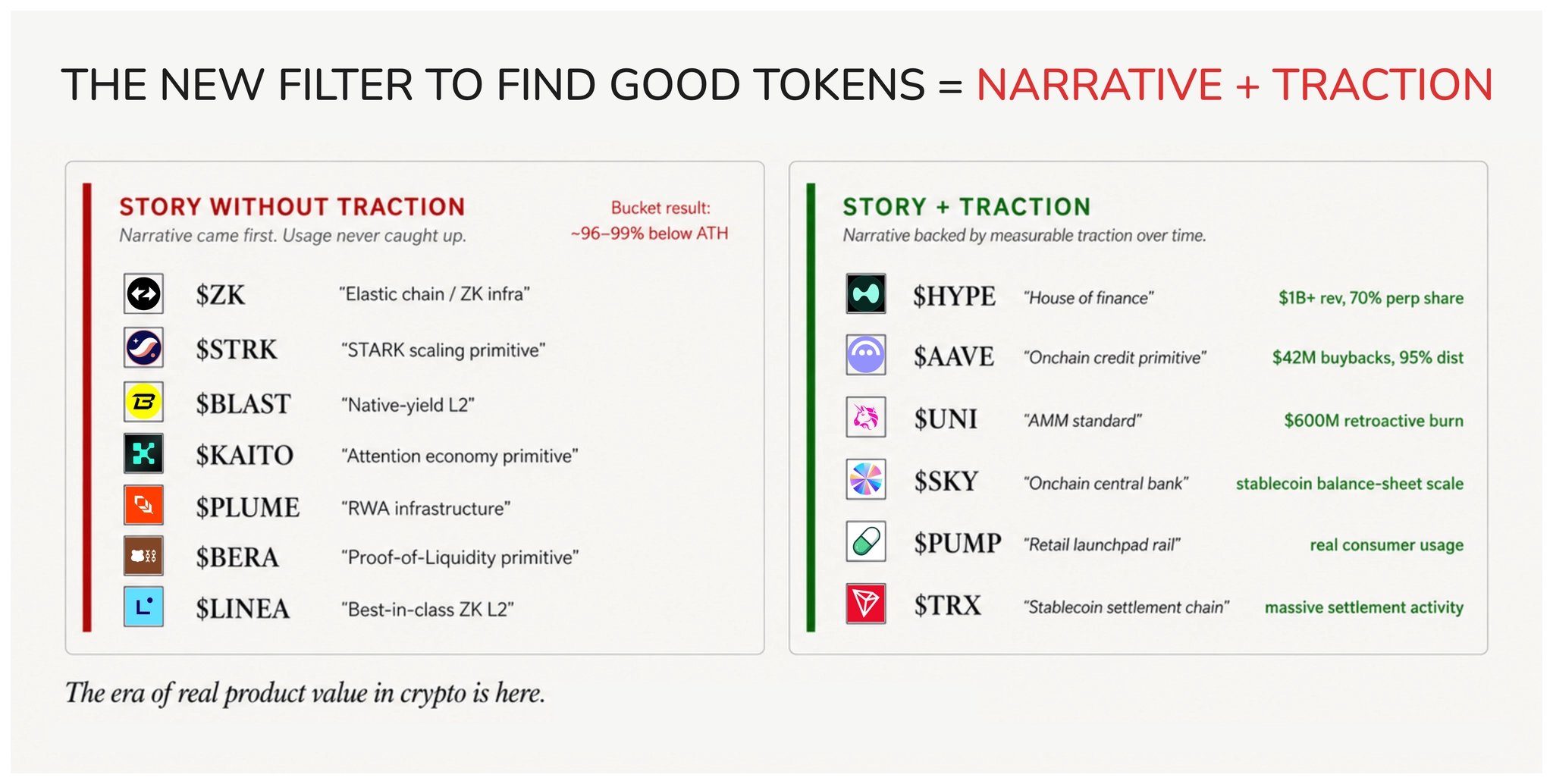
On one side, you have tokens where the narrative came first and the usage never caught up.

The market has been brutal to that bucket:

→ $ZK, $STRK, $BLAST, $KAITO, $PLUME, $BERA, $LINEA each is down **~96-99% from ATH.**

→ All had narratives people understood, but the market no longer pays full price for projected adoption.

I don’t think the market rejected these sectors from first bucket completely.

AI attention, RWA, liquidity design, and ZK infra are still valid narratives.

The problem is that narrative without revenue, user retention, real demand, or capital flow becomes hard to defend when liquidity tightens.

When the market is risk-on, people buy future potential.

When the market becomes selective, people find real tractions such as revenue, usage,

view 94
view 28
view 9.4K
2026-06-20 12:12
Tendência de ZK após o lançamento
Altista
The market is shifting from pure narrative to emphasizing actual project value and data support, and tokens with real use cases perform better.
Detalhes

Previsão de preço

Quando é um bom momento para comprar ZK? Devo comprar ou vender ZK agora?

Ao decidir se é um bom momento para comprar ou vender ZKsync (ZK), é importante primeiro se alinhar à sua própria estratégia de trading e perfil de risco. Investidores de longo prazo e traders de curto prazo geralmente interpretam as condições de mercado de forma diferente, então sua decisão deve refletir a sua abordagem pessoal. De acordo com a análise técnica de 4 horas mais recente de ZK, o sinal de trading atual é Hold. De acordo com a mais recente análise técnica de 1 dia de ZK, o sinal atual é Vender.
52
Hold
Análise técnica de 4 horas de ZK
Última Atualização 2026-06-21 15:59:59
38
Vender
Análise técnica de 1 dia de ZK
Última Atualização 2026-06-22 00:00:00
beacon

Previsão do Beacon

Previsão Probabilística de Preço (Próximas 24 horas)
i
Aviso de Isenção de Responsabilidade de Previsões do Beacon
Os resultados dos dados exibidos nesta página são analisados com base em dados de negociação reais (OHLCV) do par de trading selecionado, juntamente com indicadores técnicos correspondentes.
Esta previsão é um produto técnico experimental, fornecida apenas para fins de referência. Ela não constitui uma orientação de investimento. Eventos inesperados no mundo real podem afetar significativamente o comportamento do mercado. Os traders devem tomar decisões com cautela.
Sobre ZKsync
ZKsync (ZK) is a cryptocurrency launched in 2024and operates on the zkSync Era platform. ZKsync has a current supply of 14,749,884,093.83028423 with 9,903,078,431.07266912 in circulation. The last known price of ZKsync is 0.01180238 USD and is up 1.44 over the last 24 hours. It is currently trading on 266 active market(s) with $16,648,551.40 traded over the last 24 hours. More information can be found at https://zksync.io/.
Leia mais
Comprar ZK
Comércio ZK