가입하기
스캔하여 앱 다운로드
iOS 및 안드로이드

ZKsync (ZK)

$
$ 0.011 (ZK/USD)
-1.99%
24H

ZKsync Live Price data

Today's price of ZKsync Is $ 0.011 (ZK/USD). With A Market Cap Of $ 116.82M USD. 24-Hour Trading Volume Of $ 498.19K USD, A 24-Hour Price Change Of -1.99%, And A Circulating Supply Of 9.90B ZK.

ZKsync ZK Price History USD

Track the price of ZKsync for today, 7 days, 30 days and 90 days
기간
변경하기
Change (%)
오늘
$ 0.00023
-1.99%
7일
$ 0.00065
5.92%
30일
$ 0.0039
-25.06%
90일
$ 0.0057
-32.82%

Own ZK Now

Buy and sell ZK easily and securely on BitMart.
Buy/Sell ZK Now
Buy/Sell {0} Now
ZKsync Market Information
가격 $ 0.011
$ 0.011 24h Range $ 0.012
All time high
‎$ 0.28‎
All time low
‎$ 0.0045‎
24시간 변동률
‎-1.99%‎
24시간 거래량
‎$ 498,185.67‎
유통량
9.90B ZK
Market cap
‎$ 116.82M‎
Max supply
21.00B ZK
Fully diluted market cap
‎$ 247.73M‎
거래하기 ZK

Earn

잔존 암호화폐를 활용하여 저축, 스테이킹 등을 통해 수동 소득을 얻으세요.
지금 사용해 보기
지금 사용해 보기

ZKsync X 인사이트

avatar
ZKsync는 기관의 보관 문제를 해결함으로써 암호자산의 대규모 기관 채택을 위한 길을 닦습니다.

보관은 모든 기관 결제 네트워크가 먼저 통과해야 하는 조용한 관문입니다

대부분의 온체인 결제 분석은 은행을 셉니다. 더 유용한 것은 수탁자를 세는 것이며, 규제 기관은 자체 준수 규칙에 따라 먼저 보유할 수 없는 자산을 결제할 수 없습니다.

이는 토큰화된 예금 및 토큰화된 펀드에 대한 관심 속에서 건너뛰는 단계입니다. 결제와 보관은 동일한 문제가 아닙니다. 은행이 레일이 빠르고 최종적이라고 설득될 수 있지만, 키, 격리 및 감사에 대한 특정 통제와 함께 적격 보관을 요구하는 사명 때문에 이를 사용할 수 없을 수도 있습니다. 보관 경로가 없으면 결제 레이어가 아무리 뛰어나도 참여할 수 없습니다.

따라서 BitGo의 기관 보관 및 Prividium과의 월렛 통합이 그 크기만큼 중요하지 않은 이유가 여기에 있습니다. 이는 또 다른 로고가 아니라, 결제가 테이블에 올라오기 전부터 모든 들어오는 기관을 차단하는 전제조건을 제거합니다.

규제 기관이 실제로 따르는 작업 순서를 고려해 보십시오:

• 규제 기관이 이미 받아들인 프레임워크 내에서 자산을 보관해야 합니다.
• 그때서야 결제할 수 있습니다. 결제는 반드시 규정에 맞는 장소에 정적으로 보관되어야 하는 자산을 이동시키기 때문입니다.
• 그때서야 네트워크 효과가 적용됩니다. 회랑은 보관과 이동이 모두 가능한 두 기관이 필요하기 때문입니다.

이러한 관점에서 볼 때 @zksync 레일에 대한 배포는 병렬 발표가 아니라 연속적인 단계입니다. 보관 통합은 결제 레이어를 데모에서 실제로 은행이 온보딩할 수 있는 것으로 전환하는 부분이며, 은행이 도착하기 전에 보관 문제가 해결되었습니다.

그 아래의 아키텍처는 별개의 공급업체 관계가 아니라 이를 견고하게 유지하게 합니다. 은행은 프라이빗 환경에서 실행되며, 제로-지식 증명과 상태 커밋만이 이더리움에 도달하고, 결제는 낙관적 챌린지 윈도우 없이 최종이며, 동일한 스택이 보관, 실행 및 상호운용성을 담당합니다.

논쟁할 가치가 있는 부분은 다음과 같습니다: 2026년 기관 경쟁은 가장 빠른 증명이나 가장 유명한 은행 로고를 가진 사람에 의해 결정되지 않을 것입니다. 처음에 자산을 보관하도록 지루하고 규제에 맞게 만든 사람에 의해 결정될 것입니다. 왜냐하면 그 단계가 모든 다른 단계를 조용히 차단하기 때문입니다.

실제로 기관 보관 및 결제 검토를 경험한 사람에게는 어느 관문이 은행이 네트워크에 참여할 수 있게 하는지 결정합니다: 결제 속도인가, 아니면 정지 상태에서 자산을 보유할 수 있는 능력인가?

view 92
view 42
view 3.0K
2026-06-20 17:38
ZK의 출시 후 추세
매우 강세
ZKsync는 기관의 보관 문제를 해결함으로써 암호자산의 대규모 기관 채택을 위한 길을 닦습니다.
avatar
zkSync는 제로 지식 아키텍처 덕분에 기관 결제에서 선도적인 장점을 가지고 있으며, 향후 18개월이 핵심이 될 것입니다.

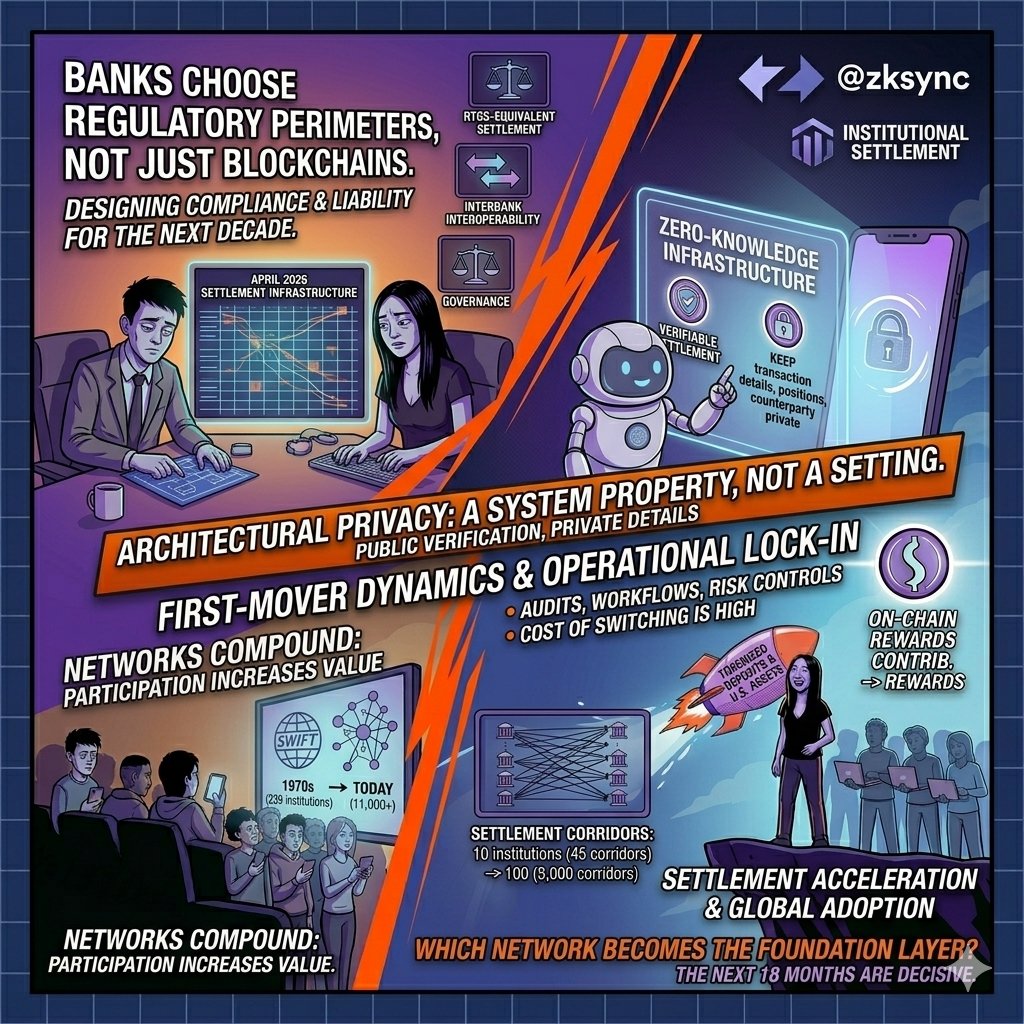
Banks aren’t choosing a blockchain. They’re choosing the regulatory perimeter they’ll operate inside for the next decade.

That’s what the 2026 settlement infrastructure decision is really about.

Right now, institutions are evaluating a set of unresolved questions that the April 2026 GFMA report identified as critical for institutional onchain finance: interbank interoperability for tokenized deposits, transaction privacy, RTGS-equivalent settlement, and governance for digital money.

These are not isolated technical features. Together, they determine whether a settlement rail can support regulated financial activity across jurisdictions.

Every rail exposes information differently. What a regulator can access, what a counterparty can infer, what an infrastructure operator can reconstruct. Those design choices shape compliance obligations, liability frameworks, and ultimately which markets a bank can operate in.

This is why privacy has become a structural issue rather than a product feature.

A privacy model that works for one jurisdiction may fail in another if confidentiality depends on permissions that can be altered later. For global institutions, privacy increasingly needs to be architectural: a property of the system itself rather than a setting that can be switched on or off.

That changes the importance of zero-knowledge infrastructure.

Instead of forcing institutions to choose between transparency and confidentiality, zero-knowledge systems allow settlement validity to be publicly verified while keeping transaction details, positions, strategies, and counterparty relationships private. Regulators can receive verifiable access without exposing sensitive information across the entire network.

For banks evaluating long-term settlement rails, that distinction matters.

The market opportunity is no longer theoretical. JPMorgan’s Kinexys platform has processed more than $1.5 trillion in transaction volume. DTCC is advancing tokenized Treasury infrastructure under existing regulatory frameworks. NYSE, BNY, and Citi are building tokenized securities rails. Meanwhile, the majority of tokenized U.S. assets already settle on Ethereum-based infrastructure.

The institutions entering these networks today are not simply choosing technology. They are helping define the standards future participants will inherit.

That is where first-mover dynamics become powerful.

Financial infrastructure compounds differently from consumer technology because adoption creates operational lock-in. Once a bank integrates a settlement rail, the costs of switching extend far beyond software migration. Institutions must repeat audits, satisfy regulators, rebuild operational workflows, renegotiate counterparty agreements, and re-establish risk controls that may have taken years to construct.

History shows how durable these effects can become.

SWIFT began with 239 institutions in the 1970s. Today it connects more than 11,000 financial institutions globally. Its dominance was not driven by superior technology alone. It persisted because every new participant increased the value of the existing network while raising the cost of choosing an alternative.

Settlement infrastructure follows the same logic.

Ten institutions create 45 potential settlement corridors. One hundred create nearly 5,000. Each additional participant increases not only transaction volume but also the number of relationships available through the network. The result is an asymmetry where the leading network's advantage compounds faster than competitors can replicate.

This is why @zksync is worth watching in the institutional race.

Its zero-knowledge architecture addresses one of the most difficult constraints identified by global financial institutions: achieving verifiable settlement while preserving confidentiality across jurisdictions. As more regulated deployments move onchain, infrastructure capable of satisfying both regulatory oversight and privacy requirements becomes increasingly valuable.

The key question is no longer whether institutional finance moves onchain.

That transition is already underway.

The question is whether privacy-preserving settlement standards can achieve sufficient adoption before regulatory fragmentation hardens into separate regional systems.

History suggests that once regulated institutions converge on a settlement standard, displacement becomes increasingly uneconomic.

The next 18 months may determine which networks become the foundation layer for institutional settlement in the decade ahead.

view 52
view 35
view 2.6K
2026-06-20 13:57
ZK의 출시 후 추세
상승세
zkSync는 제로 지식 아키텍처 덕분에 기관 결제에서 선도적인 장점을 가지고 있으며, 향후 18개월이 핵심이 될 것입니다.
avatar
시장은 순수한 서사에서 프로젝트의 실제 가치와 데이터 지원을 중시하는 방향으로 전환하고 있으며, 실제 사용 사례가 있는 토큰이 더 좋은 성과를 보이고 있다.
avatar

시장은 점점 더 선택적으로 변하고 있습니다.

투자자들이 이제 증거를 원하기 때문에 쉬운 서사 거래가 약해지고 있다고 생각합니다.

깨끗한 이야기는 여전히 관심을 끌 수 있지만, 관심만으로는 지속 가능한 가격 재조정을 만들 수 없습니다.

비교는 간단합니다:

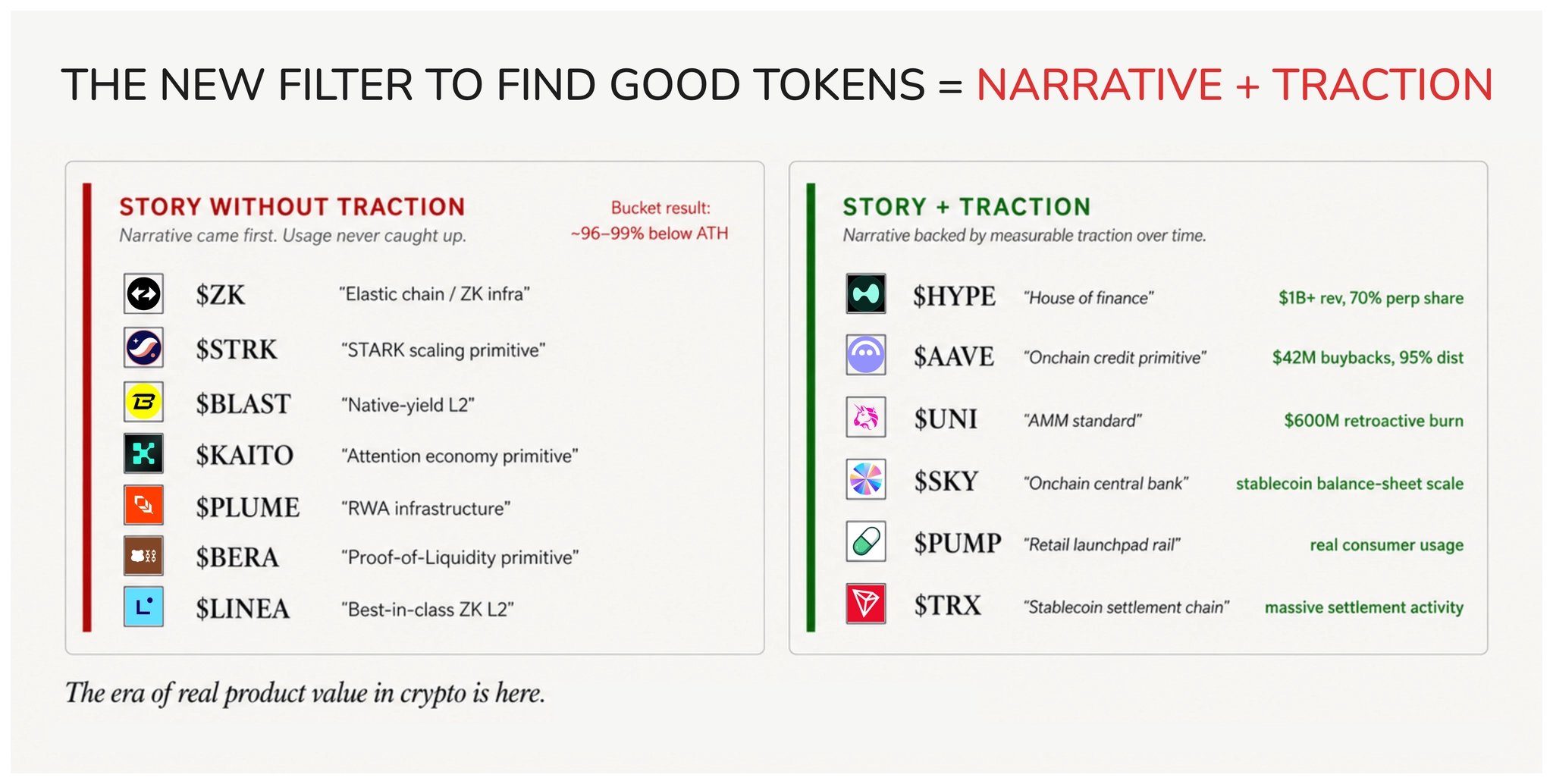
한쪽에는 서사가 먼저 나오고 사용량이 따라오지 못한 토큰들이 있습니다.

시장은 그 범주에 대해 매우 가혹했습니다:

→ $ZK, $STRK, $BLAST, $KAITO, $PLUME, $BERA, $LINEA 각각은 **역대 최고가 대비 약 96-99%** 하락했습니다.

→ 모두 사람들이 이해할 수 있는 서사가 있었지만, 시장은 더 이상 예상 채택에 대해 전액을 지불하지 않습니다.

제가 생각하기에 시장이 이 첫 번째 범주의 섹터들을 완전히 거부한 것은 아닙니다.

AI 관심, RWA, 유동성 설계, 그리고 ZK 인프라는 여전히 유효한 서사입니다.

문제는 수익, 사용자 유지, 실제 수요 또는 자본 흐름이 없는 서사는 유동성이 긴축될 때 방어하기 어렵다는 것입니다.

시장이 위험 선호일 때, 사람들은 미래 잠재력을 구매합니다.

시장이 선택적으로 변할 때, 사람들은 수익, 사용량과 같은 실제 견인력을 찾습니다,

view 94
view 28
view 9.4K
2026-06-20 12:12
ZK의 출시 후 추세
상승세
시장은 순수한 서사에서 프로젝트의 실제 가치와 데이터 지원을 중시하는 방향으로 전환하고 있으며, 실제 사용 사례가 있는 토큰이 더 좋은 성과를 보이고 있다.
세부 정보

가격 예측

When is a good time to buy ZK? Should I buy or sell ZK now?

When deciding whether it’s a good time to buy or sell ZKsync (ZK), it’s important to first align with your own trading strategy and risk profile.Long-term investors and short-term traders often interpret market conditions differently, so your decision should reflect your personal approach. According to the latest ZK 4-hour technical analysis, the current trading signal is Hold. According to the latest ZK 1-day technical analysis, the current signal is 매도.
52
Hold
4-hour technical analysis of ZK
Last Update 2026-06-21 15:59:59
38
매도
1-day technical analysis of ZK
Last Update 2026-06-22 00:00:00
beacon

Beacon Prediction

Probabilistic Price Forecast (Next 24 Hours)
i
Beacon Prediction Disclaimer
The data results displayed on this page are analyzed based on actual trading data (OHLCV) of the selected trading pair along with corresponding technical indicators.
This prediction is an experimental technical product and is provided for reference purposes only. It does not constitute investment advice. Unexpected real-world events may significantly impact market behavior. Traders should make decisions with caution.
소개 ZKsync
ZKsync (ZK) is a cryptocurrency launched in 2024and operates on the zkSync Era platform. ZKsync has a current supply of 14,749,884,093.83028423 with 9,903,078,431.07266912 in circulation. The last known price of ZKsync is 0.01180238 USD and is up 1.44 over the last 24 hours. It is currently trading on 266 active market(s) with $16,648,551.40 traded over the last 24 hours. More information can be found at https://zksync.io/.
자세히 읽어보기
매수 ZK
거래하기 ZK